
New Record Highs After AI Trade Regains Footing
Financial markets have moved into August with several competing forces. Economic and corporate fundamentals have remained supportive, as earnings growth significantly exceeded expectations with more than 80% of the S&P 500 having reported. Meanwhile, renewed geopolitical uncertainty, higher yields, and greater scrutiny of artificial intelligence investment returns has led to intense sector rotations out of and back into AI infrastructure stocks. AI investment vigor cooled in July as investors examined whether unprecedented levels of capital spending would generate sufficient returns, pressuring hyperscalers. Companies that once generated substantial free cash flow are now pouring it into investments in data centers, power, networking capabilities, and chips - with some turning to the debt and equity markets for additional cash. This is reshaping the landscape of debt markets, with Apollo’s chief economist Torsten Slok commenting in a note this morning that: “AI-related issuance already accounts for nearly 40% of longer-duration investment grade corporate bond supply, and the financing needs are only getting larger. We estimate the AI ecosystem could fundamentally support more than $2 trillion of additional investment grade debt…”. Credit spreads have remained broadly contained, supported by sound underlying corporate fundamentals and strong demand. Below the surface, however, spreads amongst hyperscalers and other AI-related issuers have widened as the market recalibrates to the means with which the AI buildout is being financed. This has prompted a deviation in the performance of hyperscaler bonds versus the broader investment grade market as investors are being asked to absorb a considerable increase in issuance.
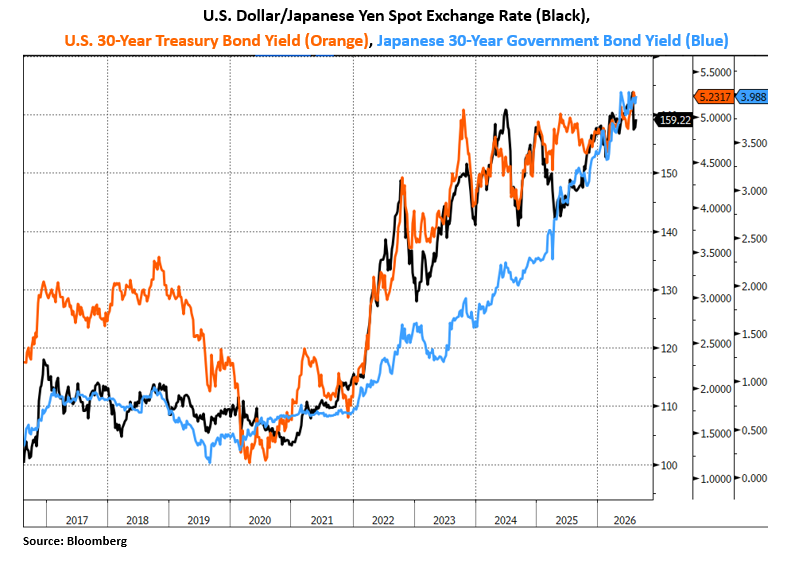
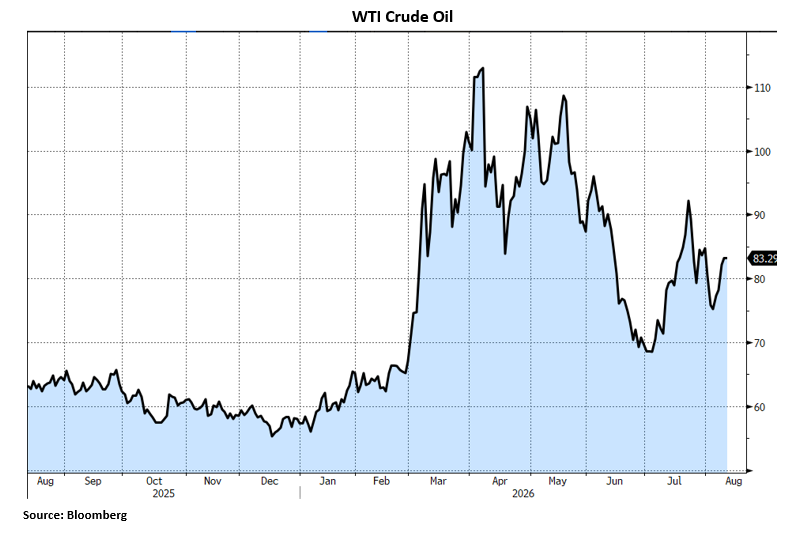
These large debt issuances, above-target inflation, energy market volatility, and fiscal concerns have pressured the long end of the U.S. Treasury yield curve with the 30-year yield reaching its highest level since 2007. The stress has not been limited to U.S. bond markets, with long-dated Japanese Government Bonds (JGBs) reaching all-time highs in yield as concerns over Japan’s own monetary and fiscal policy come to a head. The situation in Japan is particularly precarious because the Japanese Yen had fallen to a 40-year low versus the U.S. dollar, which elicited an unconventional joint currency intervention between the U.S. Treasury Department and Japan, the first such joint operation since 1998. From the U.S. perspective, there was concern over a potential scenario where Japan (the largest foreign holder of U.S. government debt) would need to sell large quantities of U.S. Treasuries to finance the intervention, and that any further pressure on the U.S. bond market could ripple through the financial system with unanticipated effects.
The Federal Open Market Committee held its key interest rate steady at 3.50% to 3.75% on a 9 to 3 vote at their July meeting. Three regional presidents dissented in favor of a hike, and as expected, Fed Chair Warsh offered little-to-no forward guidance in either the policy statement or post-meeting press conference. The Fed stated “economic activity is expanding at a solid pace despite elevated uncertainty that owes, in part, to the conflict in the Middle East.” Their review found the labor market situation as stable, leaving price stability as their major test. Policymakers will see additional labor and inflation reports prior to the September meeting. Market participants will be listening closely to Fed Chair Warsh’s remarks at the central bank’s annual Jackson Hole symposium later this month for any clues around future policy signals.
Episodes of volatility can help renew investors’ interest in steady, cash-generative businesses in sectors like energy, healthcare, financials, and staples. Quieter summer months, along with active conflicts, constant headlines, and public commentary from officials can harvest and amplify sizable moves in markets. As always, our focus remains on strong balance sheets, robust business models, and valuations that provide some relative level of comfort.
Ryan Babeuf, CFA
Market Strategist
Ryan.Babeuf@EdgeWealth.com
Past performance does not guarantee future results. Different types of investments involve varying degrees of risk, and there can be no assurance that the future performance of any specific investment, investment strategy, or product directly or indirectly referenced will be profitable, equal any corresponding indicated historical performance level, or be suitable for your portfolio. Due to various factors, including changing market conditions, the content may no longer be reflective of current opinions or positions. This content does not serve as the receipt of, or as a substitute for, personalized investment advice from Edge Wealth Management, LLC. If you have any questions about the applicability of any content to your individual situation, we encourage you to consult with the professional advisor of your choosing. A copy of our current written disclosure statement discussing our advisory services and fees is available for review upon request or by selecting “Part 2 Brochures” here.